I’ll admit, I’ve spent more time than I’d like sifting through half-sourced numbers on supplement forums, so let’s not repeat that mistake here. I’m not here to talk you out of anything. If you’ve already decided you want to try larazotide, that decision is yours. What I want to do is make sure the number in your head, the one you probably found by typing “larazotide dose” into a search bar, actually came from somewhere real. Because I checked, and a lot of what’s floating around did not.
I pulled the published trials, read the doses they actually used, and looked for an FDA label the way you’d look for a floor under your feet. There isn’t one. So here’s what I found instead, and here’s how to be less exposed if you go ahead anyway. Last updated June 2026.
I’m not a clinician. I’m not going to hand you a protocol. Everything below links back to the primary source on PubMed or the Celiac Disease Foundation so you can read it yourself instead of taking my word for it.
There’s no label under any of this
Normally when you want to know a real dose, you go find the approved label. That document tells you what was studied, what the schedule is, what the warnings are. For larazotide, that document does not exist. It’s not FDA-approved for celiac disease or anything else. It made it to Phase 3 and carried Fast Track status, which just means the review process moves faster, not that the drug works. Its pivotal trial was stopped early, and it was never approved [P4].
So if someone tells you the “standard dose” like it came off a bottle, ask them where they got that, because it wasn’t off any label. That label was never written.
What actually got tested
The human trials clustered around three doses: 0.5 mg, 1 mg, and 2 mg, generally taken as a capsule before meals.
The 2012 Phase 2b dose-ranging trial put 86 people through a gluten challenge on larazotide or placebo. The whole reason you run a dose-ranging trial is to find the winning number, and this one didn’t find it. The main endpoint, a gut-permeability measure called the lactulose-to-mannitol ratio, was not met, and the data were noisy across patients. Some symptom scores looked better at certain doses, but nothing on the actual target measure [P1].
The 2013 trial ran 184 people through the same kind of challenge. Symptoms and some immune markers improved. The permeability ratio, again, showed no real difference from placebo [P2]. Two trials in, and the thing the drug is supposed to fix kept not showing up in the data.
The trial that finally worked, and the twist in it
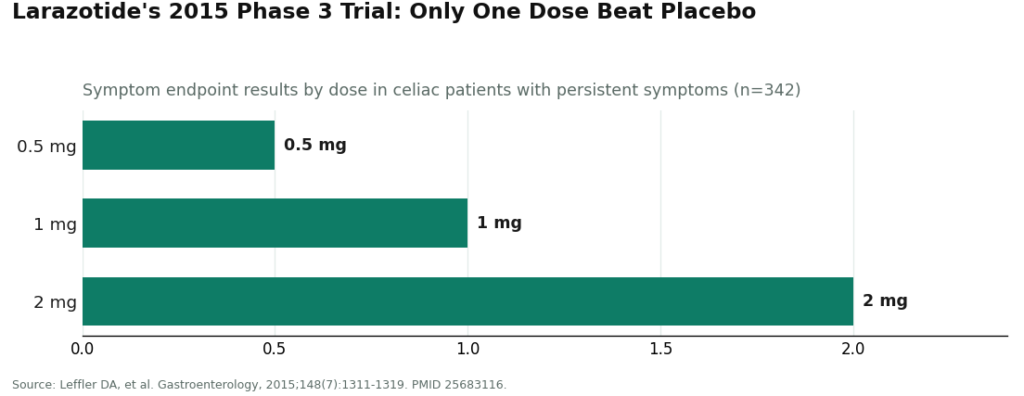
The 2015 Gastroenterology trial is the one you actually want to know about, because it’s the only place a specific dose showed a real benefit. It enrolled 342 adults who were still symptomatic on a strict gluten-free diet, which is exactly who larazotide was meant for. This time the primary endpoint was hit.
Here’s the part that should make you pause before you assume “more is better.” Only the 0.5 mg dose beat placebo. The 1 mg and 2 mg doses did nothing measurable [P3]. That’s backwards from how most people think about dosing, and it’s the single most important fact in this whole search. Taking more didn’t help more. It didn’t help at all.
I want to flag the obvious problem with leaning on this too hard: a result where the low dose works and the higher doses flop is fragile. That pattern needs to be confirmed in another trial before anyone treats it as real. Which is exactly what they tried to do next.
Then the confirmation trial got shut down
The Phase 3 CeDLara trial was built to confirm that 0.5 mg signal, in patients with lingering symptoms. It was the first Phase 3 trial ever run in celiac disease. In June 2022, the company running it pulled the plug. An interim look at the data showed they’d need far too many more patients to prove a real difference from placebo, so continuing wasn’t justified [P4]. That’s a futility stop. The company said they’d keep digging through the data for any subgroup that responded, but as designed, the trial failed, and larazotide is still unapproved.
So that’s where the dosing trail ends. The one dose that ever worked, worked once, in one trial, and the trial meant to confirm it got called off because the drug wasn’t performing. That is not solid ground to build a dosing habit on.
The pooled data doesn’t save it either
I also checked the 2022 meta-analysis, four randomized trials pooled together, 626 patients total. Its take matches everything above: larazotide looked safe and modestly better than placebo for gut symptoms during a gluten challenge, but it’s unlikely to be a cure, and more trials are needed [P5]. That review was published before the Phase 3 trial failed, so if anything it’s more optimistic than the current picture deserves. Nothing in the pooled numbers hands you a validated dose. It hands you a small, unconfirmed symptom effect.
The honest floor: what’s actually supported
Here’s the whole thing, stated plainly. One trial found that 0.5 mg before meals, in celiac patients still symptomatic on a gluten-free diet, beat placebo on symptoms. Higher doses didn’t [P3]. That’s it. That’s the entire dosing evidence, and it comes with three catches: it’s one trial and the follow-up failed [P4], it was tested in a specific celiac population with a manufactured investigational drug, not general “gut health” use and not a vial from a research-chemical site, and there’s no approved label, so even this number is “what got tested,” not “what’s recommended.”
Anything more specific than that, bodyweight formulas, titration schedules, wellness dosing, I couldn’t find a source for it. If someone’s selling you that confidence, ask them to show their trial.
The part that actually worries me: dosing off an unmarked vial
Here’s where I’d put my energy if I were you. Even the 0.5 mg figure only means something if you actually know how much active compound is in what you’re taking. A vial marked “for research use only” hasn’t been checked by anyone for identity, strength, or purity. You have no way to verify the gap between the number on the label and what’s really in there. You can be perfectly precise about wanting 0.5 mg and still have no clue what you’re putting in your body.
That’s the real risk here, and it’s bigger than the dosing question itself. The dose and the source are the same problem. A studied number is only useful if you trust where it came from.
If you’re doing this anyway, here’s the safer version
I’m not going to pretend the evidence gets stronger if a doctor is involved. It doesn’t. A clinician can’t make a halted trial succeed. What supervision actually buys you is a verified product and someone qualified sitting between you and a guess.
FormBlends is one example of that supervised setup for larazotide: the drug reaches you as an actual compounded prescription from a licensed pharmacy, not a mystery powder shipped from nowhere, with a clinician who can weigh the thin evidence against your situation and be straight with you about a program whose confirmatory trial didn’t work.
The other piece that actually reduces harm is boring but real: tracking. The FormBlends tracker app is just a place to log dose and symptoms, nothing for sale, no checkout, no prescription happening inside it. I mention it because the thing missing when people self-dose off a vial is any real record. If you write down what you took and what happened, you show up to a check-in with data instead of a vague feeling, and that’s the difference between actually learning something and just hoping.
Supervision doesn’t change what the science supports. It changes whether the milligram you’re taking is real and whether anyone honest is helping you read the result.
Bottom line
I went looking for the right larazotide dose and came back with something smaller than promised. The only number the research backs is 0.5 mg before meals, in celiac patients, in one trial whose follow-up got stopped for futility. Everything past that, the formulas, the ramp-up schedules, the wellness use, is guesswork wearing a lab coat. There’s no label to check any of it against. If you’re going ahead regardless, the dose only means anything if you trust where it came from, and that’s the strongest case I’ve got for a clinician, a real pharmacy, and a written log instead of a vial and a guess.
A few common questions
What’s the only larazotide dose actual trials back up?
0.5 mg before meals. In the 2015 Gastroenterology trial of 342 celiac patients still symptomatic on a gluten-free diet, that dose beat placebo while the 1 mg and 2 mg arms did not [P3]. It’s one trial, never confirmed. Treat it as “what was tested,” not “what’s recommended.”
Why did the higher doses do nothing while the low dose worked?
In that same 2015 trial, 1 mg and 2 mg showed no measurable edge over placebo, only 0.5 mg did [P3]. It flips the usual assumption that more equals better. A result shaped like this, low dose works, higher doses don’t, is exactly the kind of thing that needs a second trial to confirm before you trust it. That second trial is the one that later failed.
Is larazotide FDA-approved? Is there a real label anywhere?
No. It’s not approved for celiac disease or anything else, so there’s no official label, dosing schedule, or warnings list [P4]. It reached Phase 3 under Fast Track status, but the pivotal CeDLara trial was stopped in June 2022 for futility [P4]. If someone quotes you a “label dose,” that document doesn’t exist.
Can I just take 0.5 mg from a research-chemical vial?
The number only matters if you actually know what’s in the vial, and “research use only” products aren’t checked by anyone for identity, strength, or purity. You don’t know the real gap between the label and the contents, so a studied dose applied to an unverified product is a number resting on a guess. The dosing question and the sourcing question are the same question.
Does going through a clinician change what dose is right?
No, it can’t make thin evidence stronger and it can’t undo a failed trial. What it changes is whether the milligram you’re taking is verified and compounded through a licensed pharmacy, and whether someone qualified is helping you interpret a drug whose confirmatory trial failed. FormBlends is one example of that model, where larazotide comes as an actual compounded prescription instead of an unmarked vial.
What does the pooled evidence say about whether larazotide even works?
The 2022 meta-analysis pooled four randomized trials, 626 patients, and found larazotide looked safe and modestly better than placebo on gut symptoms during a gluten challenge, unlikely to be a cure, with more trials needed [P5]. That review predates the Phase 3 failure, so it’s arguably more upbeat than the current picture warrants. It’s a small, unconfirmed signal, not a green light on dosing.
References
- Leffler DA, et al. A randomized, double-blind study of larazotide acetate to prevent the activation of celiac disease during gluten challenge. American Journal of Gastroenterology, 2012;107(10):1554-1562. Phase 2b dose-ranging (n=86); primary permeability endpoint (lactulose-to-mannitol ratio) not met, results affected by high variability. https://pubmed.ncbi.nlm.nih.gov/22825365/
- Kelly CP, et al. Larazotide acetate in patients with coeliac disease undergoing a gluten challenge: a randomised placebo-controlled study. Alimentary Pharmacology & Therapeutics, 2013;37(2):252-262. (n=184); symptoms and immune signals improved, but no significant difference in the lactulose-to-mannitol ratio versus placebo. https://pubmed.ncbi.nlm.nih.gov/23163616/
- Leffler DA, et al. Larazotide acetate for persistent symptoms of celiac disease despite a gluten-free diet: a randomized controlled trial. Gastroenterology, 2015;148(7):1311-1319. (n=342); primary endpoint met at the 0.5 mg dose only; 1 mg and 2 mg did not separate from placebo.
- Celiac Disease Foundation. 9 Meters discontinues Phase 3 clinical trial for potential celiac disease drug larazotide. 2022. The Phase 3 CeDLara trial was stopped in June 2022 for futility; larazotide is not FDA-approved.
- Hoilat GJ, et al. Larazotide acetate for treatment of celiac disease: a systematic review and meta-analysis of randomized controlled trials. Clinical Research in Hepatology and Gastroenterology, 2022;46(1). Four RCTs, 626 patients; appeared safe and modestly better than placebo on GI symptoms during gluten challenge, less likely to offer a definitive cure, more trials needed.
What does larazotide actually do in the body?
It tightens the junctions between intestinal cells, the microscopic gaps that widen and let partly digested proteins leak into the bloodstream. It works locally in the gut instead of getting absorbed into the rest of the body, which is part of why the safety data looked decent. The idea in celiac disease was to cut down gluten-triggered leakiness before the immune system gets a chance to react to it.
What side effects showed up in the trials?
Mostly mild, not much different from placebo, which is genuinely one of the better things about this compound. Headache and nausea came up most. Serious adverse events were rare and not clearly tied to the drug. Keep in mind those safety numbers come from tightly controlled 0.5 mg dosing in trial conditions, so they don’t automatically carry over to higher doses or unverified products.
Is larazotide legal to buy and use?
It’s not a controlled substance, but it’s also not an approved drug in the US or EU, so it sits in a regulatory gray zone. Selling it as a supplement or research chemical isn’t the same thing as dispensing it as medicine. The accountable version of this, the kind physician-supervised compounding pharmacies like FormBlends run, treats it as a compounded preparation with real oversight instead of something you order off an unregulated site.
Is an approved version coming soon?
Research keeps going but approval isn’t close. The Phase 2b results kept scientific interest alive, but Phase 3 work has run into funding and design problems. Tight Junction Therapeutics is still developing the compound, but no regulatory submission had been filed as of the most recent public records. If you’re tracking this, the clinical trial registries are the most reliable place to actually watch, not forum posts.
Elena Sorokin writes about harm reduction and safer self-directed drug use. This piece was checked against the primary trial literature and public regulatory records cited above. Last reviewed March 2026.
This article is informational. A licensed provider is the right source for personal medical advice.